
Updated October 2026. AGIS fees, office rules and FCT land policies change often, so confirm every figure at the office or with a lawyer before you pay.
If you buy, sell, inherit or build on land in Abuja, you will deal with AGIS sooner or later. AGIS stands for Abuja Geographic Information Systems. It is the part of the Federal Capital Territory Administration (FCTA) that keeps the computer records for land in the FCT. Every genuine plot in the territory should have a file there, and AGIS is where you check whether a title is real before you pay for it.
This guide covers AGIS’s services, the land search process, the fees AGIS lists, timelines, the big changes of 2024 to 2026, and how to avoid land fraud. One warning: in 2026 the AGIS website (agis.fcta.gov.ng) has carried injected spam links to gambling sites in its page footers. We use its fee pages as a guide, but do not click links on it. Visit the office, or work through a lawyer.
What AGIS is and why it exists
The problem it was set up to solve
Before AGIS, FCT land records were kept on paper. A 2006 conference paper by an AGIS officer, Ibrahim Usman Jibril, listed the problems this caused: the same plot allocated to more than one person, forged documents, unauthorised allocations, buildings on road and drainage reserves, and lost revenue.
In 2003 the Federal Government decided to computerise the FCT’s cadastral (plot map) and land registry records. That decision led to AGIS. The FCTA website says AGIS was established under FCT subsidiary legislation in 2004. By 2006 the project had scanned and digitised more than 15,000 Title Deed Plans and mapped about 32,000 plots in Phases I and II of the city.
What AGIS does today
The FCTA describes AGIS as the only official source of geospatial (map and location) data for the FCT. It produces Certificates of Occupancy (C of O), Rights of Occupancy (R of O) and Title Deed Plans; keeps land records and does title searches; processes land applications; collects land revenue such as ground rent; handles street naming and house numbering; and supplies maps and satellite images.
AGIS works closely with the FCT Department of Land Administration. In simple terms, the Department of Land Administration handles the legal side (allocations, consents, revocations), while AGIS holds the computer records, maps and title production. Many land notices are issued by both together.
Who runs AGIS
In May 2026, the long-serving AGIS director, Esv. Umar Sayyadi, retired after 35 years in the FCTA, according to Daily Times. HousingTV Africa reported in June 2026 that Alakirawa Ularam had been appointed to oversee AGIS from 29 May 2026. Some reports describe him as acting director and others as overseeing director.
Where AGIS is and when it opens
The FCTA’s own website gives the AGIS address as Plot 1, Kapital Street, Area 11, Garki, Abuja (PMB 24). Other listings, including a page on the AGIS website and the business directory Finelib, give No. 4 Peace Drive, described in different places as Area 11 Garki or the Central Area. Because the listings do not agree, call before you go and ask for directions to the customer service desk.
- Office hours: Monday to Friday, 8am to 4pm (as listed by AGIS and Finelib).
- Service desk hours: AGIS says its customer desks attend to the public from 9am to 3pm on working days. Applications that arrive late are treated as the next day’s work, so go early.
- Customer care lines listed by AGIS: 0809 015 4777 and 0805 071 5299.
- What to bring: originals and photocopies of every document, a valid ID and passport photographs.
Services AGIS offers
Legal search (land search)
This is the service most buyers need. It shows who the records name as the holder of a plot, whether the title is genuine, and whether anything such as a mortgage is registered against it. See the step-by-step section below.
Title registration and Minister’s consent
In the FCT, land belongs to the Federal Government under the Land Use Act of 1978, and statutory rights of occupancy are granted by the FCT Minister. This means you cannot simply sell or mortgage a plot. Most transactions need the Minister’s consent and then registration at AGIS. AGIS lists processes for:
- Deed of Assignment or Gift (used to transfer a developed plot)
- Power of Attorney registration (often used for undeveloped plots)
- Deed of Sublease
- Consent to a legal mortgage
AGIS normally issues one C of O per plot, so later owners register their ownership through a Deed of Assignment on the same file, a 2021 Mondaq legal article explains.
C of O processing and recertification
AGIS prepares and issues Rights of Occupancy and Certificates of Occupancy. To collect an R of O, bring the original acknowledgement of your land application and a valid original ID; companies also need CAC documents and an authority letter from two directors.
Recertification means replacing an older C of O with a new one. In November 2023, FCT Minister Nyesom Wike said all C of O holders must recertify, so that new certificates carry the holder’s NIN (or BVN for companies). TheCable reported fees of ₦50,000 for individuals and ₦100,000 for companies at the time. Separately, the AGIS website lists “late re-certification” of city titles at ₦150,000. A December 2025 guide by a property firm said the process can take up to nine months. Ask at AGIS which fee applies to your title.
Regularisation of Area Council documents
Many plots outside the city centre were allocated by the six Area Councils, not by the Minister. These Area Council papers are not statutory titles. The FCTA’s regularisation exercise checks these documents and, if they are genuine, converts them into statutory titles.
In April 2025, the FCTA said 261,914 Area Council documents had been submitted for regularisation, but only 8,287 had been vetted and 2,358 regularised. It restarted the exercise from 21 April 2025. That notice was for people who had already submitted documents, not a call for new submissions. If your document passes, you receive an offer, and you must collect it, pay all the bills and submit a letter of acceptance within 60 days. After that, the offer lapses.
Site plans and survey data
AGIS’s survey unit produces site plans and survey data, finds plot locations in the field, and handles plots missing from the map, encroachment and double plot locations.
Change of ownership
There is no single “change of ownership” form. Ownership changes through the consent and registration processes above. Until consent is granted and the deed is registered at AGIS, the records still show the old owner.
Payments through Remita
AGIS bills are paid through Remita, the government’s payment platform. AGIS’s instructions are: get your bill from the account unit or customer care, then on Remita choose “Pay TSA & States”, then “Federal Capital Territory Admin”, then “Abuja Geographic Information Systems”, and select the bill type. Some older AGIS pages still mention paying at designated banks. Never pay land fees into a personal bank account.
Online services
The AGIS website describes a customer portal for ground rent, application tracking and title verification. We could not confirm how well it works in October 2026, and because of the spam links we do not recommend using links from the site. We found no confirmed launch of a fully digital FCT title (e-C of O).
How to do a land search at AGIS: step by step
These steps follow AGIS’s published process and an August 2025 guide by a law firm. Rules can change, so confirm at the desk.
- Get the plot details from the seller: plot number, district, file number and a copy of the title. A seller who will not give a file number is a warning sign.
- Pay the search fee through the approved channel, then take your payment evidence to the Finance desk for an official receipt.
- Write an application letter to the Director of Land Administration with your name, signature, phone number and the exact plot details.
- Present the original title and a valid ID. A desk officer marks the application “original sighted” and dates it. In practice, you usually need the title holder’s cooperation, or a lawyer acting for you.
- Submit at the Legal Search desk with your receipt attached.
- Collect the result. AGIS says it is usually ready within 24 hours, and at the latest within three days.
Documents you need
- Application letter to the Director of Land Administration
- Original title document (for sighting) and a photocopy
- Valid ID (international passport, national ID card or driver’s licence)
- Official payment receipt
What to check in the result
Compare the name on the search with the seller’s ID, and check that the plot number, size and district match your documents. Ask whether there is a mortgage, caveat or revocation on the file, and whether ground rent is paid up. Then search again shortly before you pay the final amount. In a 2025 fraud trial, Premium Times reported, a buyer testified that land records he had confirmed on AGIS later “disappeared from the system”.
AGIS fees (and why you must confirm them)
The figures below come from AGIS’s own process pages. The pages are not dated, so treat them as a starting point and ask for your actual bill before paying.
| Service | Fee listed by AGIS |
|---|---|
| Legal search, individual/private file | ₦10,000 |
| Legal search, commercial/corporate file | ₦20,000 |
| Site plan or survey data, residential plot | ₦10,000 |
| Site plan or survey data, commercial plot | ₦20,000 |
| Power of Attorney registration | ₦102,000, plus ₦2,000 per extra copy |
| Deed of Assignment or Gift | 8% of property value |
| Deed of Sublease | 2% of consideration, plus ₦10,000 consent fee, ₦10,000 processing fee, ₦2,000 per counterpart copy |
| Consent to legal mortgage | 1% of consideration, plus ₦10,000 consent fee, ₦10,000 processing fee, ₦2,000 per counterpart copy |
| New land application form | ₦100,000 |
| Late re-certification of city titles | ₦150,000 |
| Area Council regularisation form | ₦5,000 |
A note on consent fees. AGIS lists 8% of the property value for a Deed of Assignment. Property guides published in 2026 quote lower figures for the Minister’s consent, such as “about 3%” or “3% to 6%”, and one gives 5% to 8% for stamping, consent and registration together. These figures do not match, and the final bill often depends on the FCTA’s valuation of your property. Stamp duty, ground rent arrears and lawyer’s fees come on top, so ask your lawyer for a written estimate before you sign anything.
Typical timelines
- Legal search: 24 hours to three days (AGIS).
- Site plan or survey data: within 12 hours after you submit and pay, according to AGIS. Other survey unit services can take up to five working days.
- Minister’s consent and registration: property guides published in 2026 say two to four months, and sometimes longer.
- C of O recertification: up to nine months, according to one 2025 guide.
- Paying for a new statutory R of O: under the April 2025 reforms, you have 21 days from the date of the offer to pay all charges and accept it. Late payment is not valid.
- Building on a new allocation: you must develop the land within two years of the R of O’s start date, or it can be revoked.
AGIS and FCT land news, 2024 to 2026
Ground rent revocations
Ground rent is due every year on 1 January. In March 2025, the FCTA revoked 4,794 land titles over unpaid ground rent, mostly in the oldest districts such as the Central Area, Garki, Wuse, Asokoro, Maitama and Guzape. Nairametrics reported that 8,375 owners owed about ₦6.97 billion at the end of 2024, and some had not paid for up to 43 years.
In late May 2025, after President Tinubu intervened, the FCTA paused enforcement and gave defaulters 14 days to pay arrears plus penalties: ₦5 million in the Central Area, ₦3 million in Maitama, Asokoro, Wuse II and Guzape, and ₦2 million in Wuse I, Garki I and Garki II, The Abuja Inquirer reported. In November 2025, the FCTA moved against 1,095 properties in Asokoro, Maitama, Garki and Wuse: 835 for unpaid ground rent and 260 for land use conversion fees and other penalties (Channels TV).
485 Area Council documents nullified (February 2026)
On 24 February 2026, the FCTA revoked 485 Area Council land allocations that had been submitted for regularisation but failed authenticity checks, BusinessDay reported. The affected layouts included Ushafa and Dawaki Extension in Bwari; Kurudu, Karu Village Extension, Nyanya Phase IV Extension, Jikwoyi, Sabon Lugbe and Lugbe I Extension in AMAC; and Kuchiyako in Kuje. The FCTA said the documents were fake or not genuine. This was about forgery, not unpaid ground rent. If you hold Area Council papers in these layouts, see a lawyer.
April 2025 reforms and other changes
The reforms announced on 11 April 2025 (in force from 21 April) brought the 21-day payment window, the two-year building rule and the 60-day window for regularised Area Council documents described above. In September 2026, the Department of Land Administration also reconstituted its Alternative Dispute Resolution Committee, which settles land disputes through mediation instead of court.
How to avoid fake agents and land fraud
We did not find a 2024 to 2026 FCTA notice about fake “AGIS agents” specifically, but the risk is real. In 2020 the FCTA admitted that some of its own officials had helped outsiders issue fake allocation letters, and in 2025 the EFCC was prosecuting an Abuja realtor and her company over fraudulent land sales.
- No one can “speed up” AGIS for a cash fee. Be wary of anyone near the office who says they work inside AGIS or have “connections”.
- Pay only through official channels, such as Remita. Never pay government fees into a personal account.
- Do your own search, or let your own lawyer do it. Do not rely on a “search report” handed to you by the seller or agent.
- Check that the agent is registered. A 2026 buyer’s guide suggests checking estate surveyors and valuers against the ESVARBON register and asking for a current practising licence.
- Watch for classic warning signs: a price far below the market, no file number, pressure to pay quickly, and more than one person claiming the same plot.
- Be careful with Area Council papers. They are not statutory titles until regularised, and forged ones are common.
Our guide to common scams in Abuja covers more tricks, including land and rental fraud.
Practical tips for your AGIS visit
- Ask for a written bill before you pay, and check that the plot details on it are correct.
- Keep a file of every receipt, acknowledgement slip and letter. You will need them for later steps.
- Check your ground rent every January. Unpaid ground rent was the main reason titles were revoked in 2025.
- If you live abroad, give a lawyer a limited power of attorney for the specific transaction, rather than relying on a relative or an agent.
Before you commit to any plot, go through our buying property in Abuja checklist.
Frequently asked questions
How much is a land search at AGIS?
AGIS lists ₦10,000 for an individual file and ₦20,000 for a commercial or corporate file. Its fee page is not dated, so confirm the current amount at the office. Your lawyer will charge a separate fee if they do the search for you.
How long does an AGIS search take?
AGIS says results are usually ready within 24 hours, and at the latest three days, counted from when you submit the application with your receipt. Expect delays around ground rent deadlines, when the office is crowded.
Can I check my land on AGIS online?
The AGIS website describes an online portal for ground rent, tracking and title verification. But the site has carried spam links in 2026, and we could not confirm how reliable the portal is. For anything you are paying money for, do a physical search at AGIS or through a lawyer.
Are Area Council land papers valid?
Area Council documents are not statutory titles. The FCTA is checking them through a regularisation exercise, and in February 2026 it revoked 485 that failed authenticity checks. If you hold one, ask AGIS whether it has been regularised before you build or sell.
What is the Minister’s consent fee in Abuja?
AGIS lists 8% of the property value for a Deed of Assignment, but 2026 property guides quote lower figures of about 3% to 6%. The amount usually depends on the FCTA’s valuation. Get a written estimate from your lawyer.
The bottom line
AGIS is the one place that can tell you whether an Abuja plot is genuine, who holds it, and what is owed on it. A legal search costs little compared with the price of land and is the best protection you have. Do it through your own lawyer, repeat it just before you pay, pay only through official channels, and pay ground rent every year.
The rules have tightened since 2025, with strict payment windows, a two-year building deadline and mass revocations. If you are planning to buy, start with our buying property in Abuja checklist, and if you are still choosing an area, see our guide to new areas to invest in Abuja.
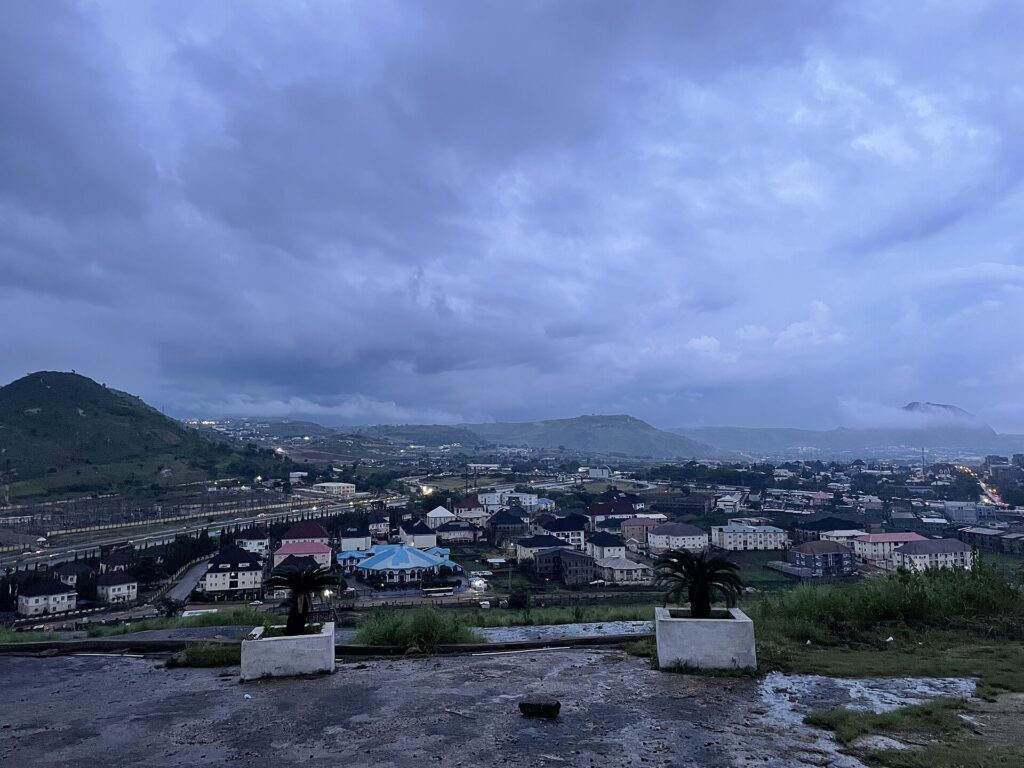
Cover photo: A view over Abuja from Katampe Hill. Photo: Ogundele1, CC BY-SA 4.0, via Wikimedia Commons